The thermal camera manufacturers you source from shape your platform's performance, lead times, and supply risk.
- Vertical integration, from infrared glass to finished camera cores, shortens engineering loops and reduces exposure to constrained materials like germanium.
- Real integration support covers optical design, interface matching, and environmental validation for your specific platform.
- Supplier qualification starts with documentation: a certified quality system, export compliance records, and traceable test data.
Bring your optics supplier in at the requirements stage, before your housing, detector, and interfaces are locked.
Thermal Camera Manufacturers Built Around Industrial OEM Needs
We design and build infrared optics, assemblies, and camera cores for industrial OEMs, condition-monitoring vendors, and system integrators.What sets us apart from many thermal camera manufacturers is that we make our own infrared glass in Orlando, so we can supply your program at whatever level you need.
That depth matters for supply security. Germanium, a longtime staple of infrared lenses, has been under Chinese export licensing controls since 2023, and the USGS estimates a total Chinese ban on gallium and germanium exports could mean a $3.4 billion GDP loss.
What Should Industrial OEMs Expect From Thermal Camera Manufacturers?
Expect a partner that designs around your platform, supports integration through production, documents its quality, and keeps materials flowing. You need industrial cameras to integrate into OEM systems with defined power budgets, enclosures, and software stacks.
Our industrial customers typically fall into three groups:
- Condition-monitoring and predictive maintenance vendors building fixed, always-on thermal systems
- Industrial OEMs adding thermal sensing to process-control or quality inspection equipment
- System integrators assembling multi-sensor platforms for plants, utilities, and energy sites
Each needs thermal imaging camera manufacturers that bridge component engineering and system-level thinking.
What Can You Source From One Supplier?
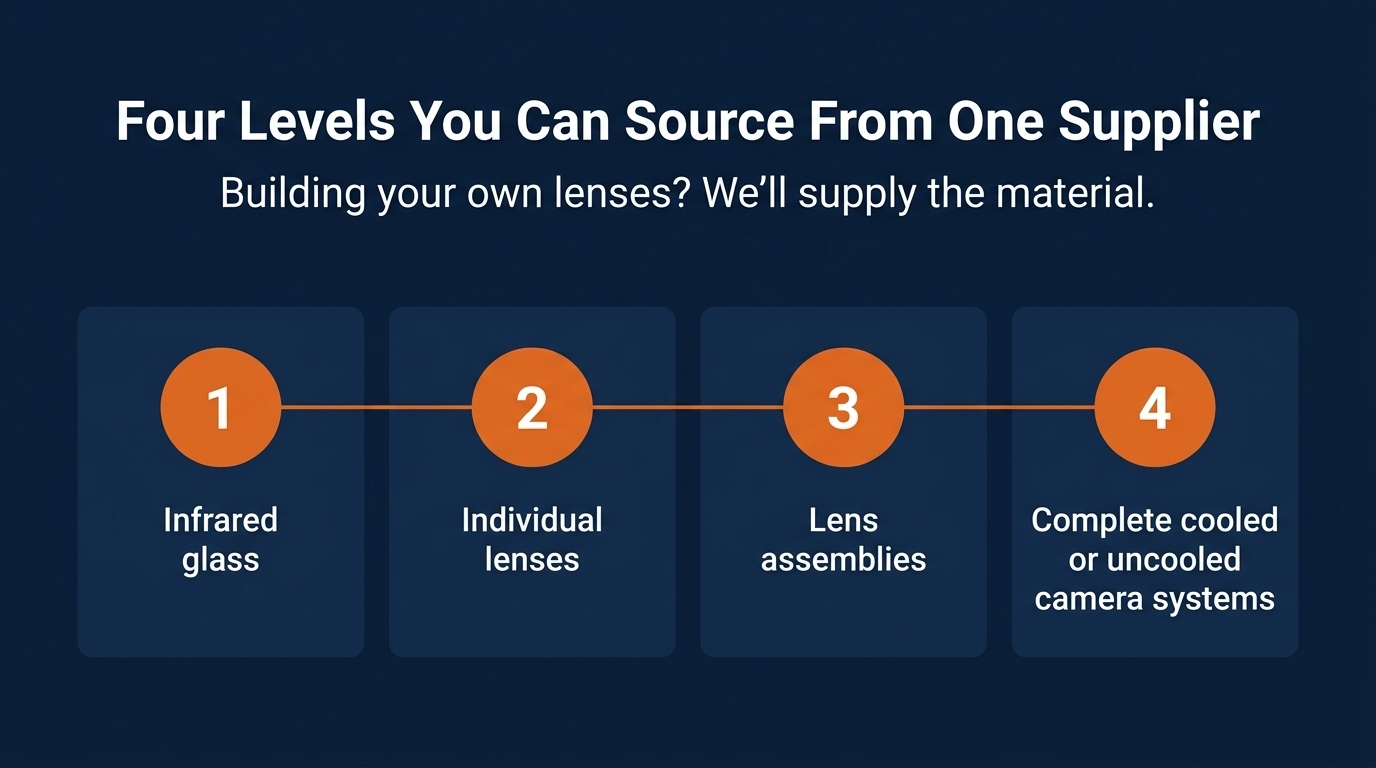
You can source four levels from us: infrared glass, individual lenses, lens assemblies, and complete cooled or uncooled camera systems. Building your own lenses? We'll supply the material.
Our camera portfolio spans uncooled LWIR (8 to 14 µm), cooled MWIR (3 to 5 µm), and Mantis broadband cameras covering 2 to 14 µm without refocusing across that range. For compact LWIR designs, our CST-SOLO S640 focal plane array delivers 640 x 480 resolution at a 10-micron pitch, with shutterless correction for uninterrupted imaging.
4 Capabilities to Verify Before You Choose a Supplier
Verify four things: material control, custom design capability, modifiable standard options, and supply continuity. These capabilities predict field support better than a spec sheet does.
1. Control Over Materials and Optics
Choose a supplier that makes its own glass, lenses, and coatings, so the optical path is tuned to your detector. Our Black Diamond™ chalcogenide glass, introduced in 2016, is a germanium-free option for many infrared designs. That means steadier material supply and fewer late redesigns.
2. Custom Optical and Mechanical Design
Look for thermal imaging camera manufacturers with in-house engineers who design lenses, housings, and mounts around your constraints. Catalog footprints rarely fit industrial platforms. We start from your requirements, so the field of view, working distance, and form factor match from day one.
3. Standard Options You Can Modify
The fastest programs start from a proven design and change only what's unique. We offer standard thermal imaging lens assemblies available off the shelf. Custom builds get a schedule defined at program kickoff.
4. Supply Continuity Over the Product Lifecycle
Ask any industrial thermal camera manufacturer you evaluate how it handles sourcing, obsolescence, and lead times across a multiyear run. In-house manufacturing gives us direct control over those variables. Your build schedule stays predictable after launch.
How Do Thermal Camera Manufacturers Support OEM Integration?
Strong suppliers support you at five stages: requirements, optical design, interface matching, environmental validation, and production. Here's what to expect at each stage when sourcing industrial cameras to integrate into OEM systems.
|
Integration Stage
|
What Your Supplier Should Provide
|
|
Requirements definition
|
Joint review of targets, working distances, operating environment, and size, weight, and power limits
|
|
Optical design
|
Lens design matched to your detector, housing, and field of view
|
|
Interface matching
|
Output options such as NTSC/PAL, CameraLink, GigE, and USB
|
|
Environmental validation
|
Testing and tuning for heat, vibration, and continuous-duty operation
|
|
Production
|
In-house manufacturing with consistent quality control
|
How Do You Qualify Certified Suppliers of Industrial Thermography Hardware?
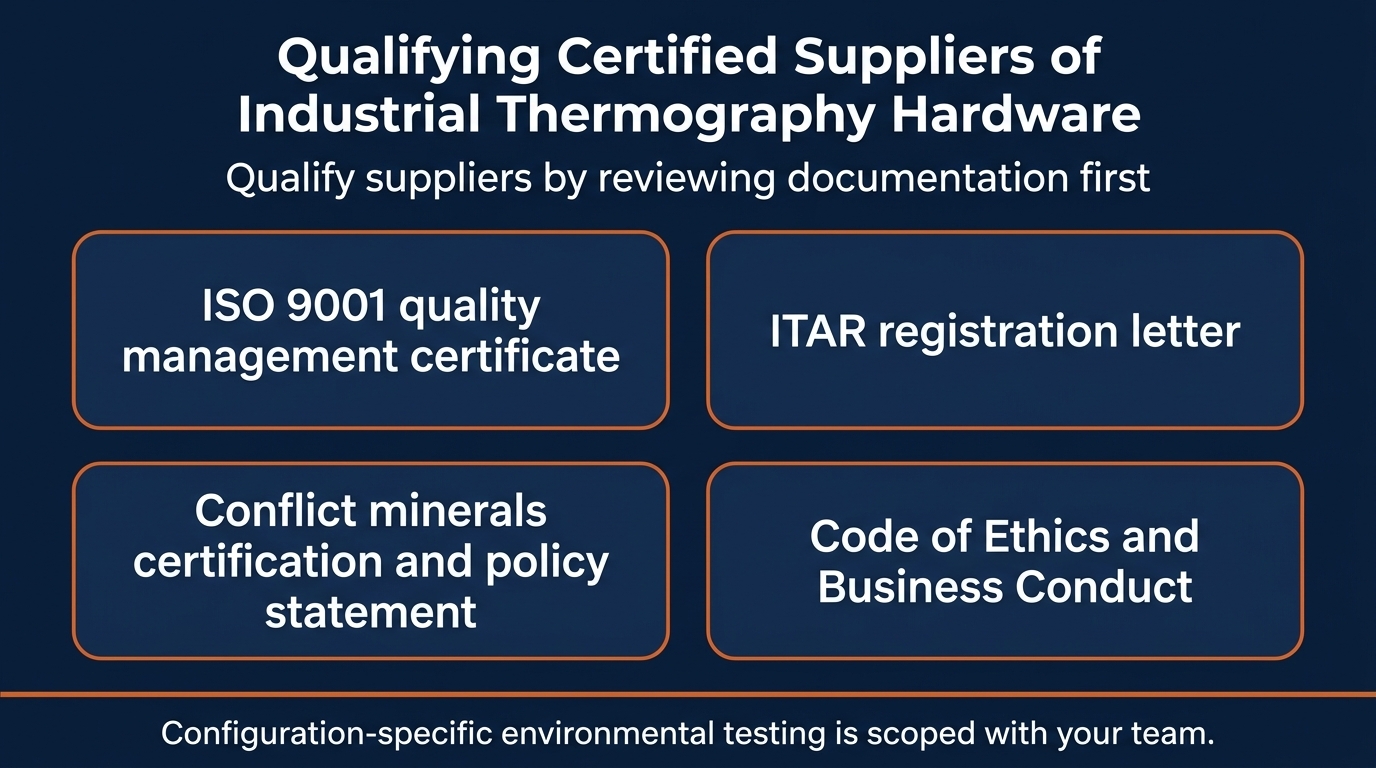
Qualify suppliers by reviewing documentation first: quality certification, export compliance, materials sourcing, and test data for your configuration. Teams vetting certified suppliers of industrial thermography components rely on this record because ISO 9001 certification is commonly requested in supplier approval and is issued by independent certification bodies.
- ISO 9001 quality management certificate, renewed for 2026
- ITAR registration letter for 2026
- Conflict minerals certification and policy statement for 2026, plus our SEC Form SD
- Code of Ethics and Business Conduct
Configuration-specific environmental testing is scoped with your team. Choosing certified suppliers of industrial thermography hardware shortens approval cycles and reduces audit risk.
Industrial Applications We Support
We support five core industrial applications: predictive maintenance, process monitoring and quality control, furnace and kiln inspection, early fire detection, and optical gas imaging. Thermal imaging performs well through smoke, steam, and darkness, though heavy rain and high-radiance sources such as direct sunlight can limit it, so we design for your real operating conditions.
|
Application
|
Typical Environment
|
Common Imaging Approach
|
|
Predictive maintenance
|
Motors, bearings, electrical systems
|
Uncooled LWIR (8 to 14 µm) fixed cameras
|
|
Process monitoring and quality control
|
Production and assembly lines
|
Uncooled LWIR with custom optics
|
|
Furnace and kiln inspection
|
Steel, glass, and chemical production
|
Rugged camera cores with borescope-matched optics
|
|
Early fire detection
|
Storage areas, conveyors, waste handling
|
Fixed uncooled monitoring cameras
|
|
Optical gas imaging
|
Refineries, pipelines, utilities
|
Cooled camera systems
|
In June 2025, we introduced our first industrial-grade cooled optical gas imaging camera, and our 2025 acquisition of G5 Infrared expanded our gas imaging and broadband capabilities. See our oil and gas imaging solutions for leak detection programs.
Frequently Asked Questions
Do you sell thermal cameras to end users?
No. We supply optics, lens assemblies, and camera cores to OEMs and system integrators who build them into larger products, such as fixed monitoring systems.
Can you supply only glass or lenses if we build our own camera?
Yes. You can buy Black Diamond™ glass, individual lens elements, or complete assemblies. Experienced thermal imaging camera manufacturers should meet you at the level your design team needs.
Where are your products manufactured?
We're headquartered in Orlando, Florida, where we run our principal production facility and make our Black Diamond™ glass. We also operate a prototyping and R&D site in Plano, Texas, cooled camera production in Hudson, New Hampshire, and an EU production hub in Riga, Latvia.
What should we have ready before a first technical call?
Bring your target application, working distance, operating environment, detector or interface requirements, expected volumes, and timeline. That lets our engineers recommend a standard or custom path in the first conversation.
What makes an industrial thermal camera manufacturer a good long-term partner?
Look for vertical integration, in-house engineering, documented quality systems, and a clear material supply plan. An industrial thermal camera manufacturer with all four can support your product from prototype through years of production.
Start Your Industrial Integration Project
The right partner helps you design faster and qualify sooner. Since 1985, LightPath has controlled every step from raw infrared materials to finished camera systems, working alongside your engineers from concept to production. Talk with our industrial team to scope your next thermal imaging program.